


Est. 1935

Ninety years ago, Utah had become a hotbed of talented writers who were pouring out their souls in the fields of poetry, fiction and commercial production. Groups of pen-wielding authors were producing books, writing for newspapers, contributing to national magazines, producing play manuscripts, and writing scripts for radio shows. Some were even writing material for Hollywood.
Well known authors such as Frank Chester Robertson (who wrote over 150 western novels during his lifetime), Olive Woolley Burt (a newspaper woman and producer of children’s books), Harrison R. Merrill (a BYU journalism professor and the editor of a number of LDS magazines), Zina Hickman (poet and newspaper woman), Rosa Lee Lloyd (short story writer and poet), Virginia Budd Jacobsen (children’s book author), Edith Mudgett Hines (society editor at the Salt Lake Telegram), Mary Hale Woolsey (lyricist of "When It’s Springtime in the Rockies" and dozens of other songs), among other writers, were very active during that time.

Early League Member
Virginia Budd Jacobsen
Groups of writers who met together regularly had sprung up in various places around Utah. Groups such as the Blue Quills (founded in 1928 and considered the oldest chapter in the LUW), the Barnacles (a writers group in Salt Lake in the 1930’s), the Short Story Club (founded around 1930) and the Writers Dramatic Guild were some of the various groups concerned with helping promote local authors. Writing and poetry were also included in activities at the well known Art Barn (which opened in 1933) on Salt Lake City’s east side during programs and presentations there. One of those programs was the Beaux Arts Ball that took place in the late winter and was packed by people wanting to see what artists, musicians, dramatists, writers and poets presented. The Art Barn is now the home of the Salt Lake City Arts Council.
With all this going on, in 1935 Lawrence Nelson, the first vice president of the League of Western Writers that was based in Seattle, Washington, wrote a letter to socialite and arts proponent Laura Sherman Gray about forming a chapter of the league in Utah. She arranged a series of meetings that with some authors and poets, many of which were named above, concerning the invitation. The consensus was to form a chapter which would become a part of a group that included chapters in western Canada, California, Washington, Oregon, Montana and Texas.
While the League of Utah Writers would not become the official name of the group until five years later, this time period is considered the beginning of the leagues long and storied history. And in those five years, the chapter would grow and become a viable power in the Utah arts community.
In the summer of 1935, Pamela Pearl Jones, the Secretary-Treasurer of the eight-year-old League of Western Writers, arrived in Salt Lake City to meet with scribes and individual writers groups who were interested in becoming part of the larger organization (Salt Lake Telegram 07/26/35). By that time a Utah chapter was assured a good start based on the positive reception the invitation to join had received when it was extended to Laura Sherman Gray earlier in the year. At the time Jones said that creative writing of all kinds would be encouraged and that chapters would be organized throughout the state.
But at this point there is some confusion in the timeline and facts between a League of Utah Writers history written in 1996 and what documents, such as newspaper reports, say happened. The history notes that meetings of selected Utah writers were held late in the fall and early winter of 1935 at Salt Lake’s Alta Club to consider putting together a group to join the League of Western Writers. These meetings would have taken place months after Jones' visit. Before those reported meetings, in October of that year, League of Western Writers President L.D. Mahone was in town not only to help complete the organization of the Utah Chapter for the League of Western Writers but to also to address a meeting of the local writing group called the Barnacles during their yearly “honor night” for outstanding literary contributions during the past season (Salt Lake Tribune 10/19/35).
Another bit of confusion arises out of discrepancies between League documents and what was reported in the press when it came to leadership of the new chapter. Gray, a well known Salt Lake socialite, was actually not a professional writer. She apparently dabbled in poetry and was well connected in the art community, which is probably why she was the one approached originally. Olive Woolley Burt was the editor of the Salt Lake Tribune's society page and was a children’s book author. It was reported that Burt had been elected the first President of the Utah Chapter of the League of Western Writers (Deseret News 11/22/35). But in numerous reports in papers throughout the next year, Gray was referred to as the President of the Utah chapter and Burt was often called the President of the Salt Lake Chapter. It seems the title of Utah president at the time was almost interchangeable with the Salt Lake group.

Laura Sherman Gray,
early president of the Utah Chapter of the League of Western Writers
Laura Sherman Gray, early president of the Utah Chapter of the League of Western Writers
The 1996 history also said the first meeting of the Utah chapter took place in January of 1936, but a Deseret News story (12/07/35) reported that the first meeting of the Salt Lake Chapter took place on December 2, 1935. In that meeting L.C. Zucker talked about some classes he had taken from Bernard De Voto that past summer at Harvard. Some in the audience knew De Voto because he was a Utah native and had attended the University of Utah at one point. By this time however, De Voto had become probably the best known writer to ever emerge from the Beehive state and had just begun writing a Harpers Magazine column called “The Easy Chair” which ran for 20 years until his death in 1955.
Also speaking at the meeting were Emerson Evans, the editor of a San Francisco magazine who spoke about what magazines want from writers; Frank C. Robertson, the author of dozens of western novels, concerning writing with a fresh point of view; and Charles G. Plummer, a representative of and one of the early writers asked to join the Western League when it was formed, who spoke about the ideals and aims of the organization.
It was also at this meeting that the announcement of the establishment of a permanent library collection, consisting of works created by Utah writers was made. It was to be housed at the Art Barn.
Regardless of the inconsistencies in historical facts, the League had begun with a bang. In the coming year it would grow with the formation of statewide chapters and hold its first annual meeting, which would later become the state convention.
At the beginning of 1936, the Utah Chapter of the League of Western Writers had been organized. It was a new year and the group needed to decide on bylaws and rules for the organization. Taking some clues from the League of Western Writers they decided to meet as a state organization once a month and limit the membership to only "professional writers.”
One of the first bylaws established was that to become full members, "authors shall have demonstrated professional writing ability by publication within a two-year period just prior to admission, in magazines of national circulation, a novel or novelette, three stories or articles, poetry or equivalent sales using any combination of the previous mentioned parameters." Members could also have full membership if they published a book (not privately printed, except poetry), scripted three radio programs, or made a sale to motion pictures in any form. Proof of submission for publication had to be evidenced by at least ten rejection slips in the year. The rejected materials must have been reviewed by a committee to be sure it was up to the League's standards. The League also had an associate member level that required the production of so many works and accompanying rejection slips.
Obviously the idea of who can belong to the League today has changed, but at the time, an organization that was started by people who had been published and were successful became the rule. The League's bylaws were not completed until 1939, so some of what happened was apparently made up as they went along, although they did have guidance from the League of Western Writers through the ensuing three years.
The organization was mostly composed of women, with a few men included. Two of those men were Frank Robertson, who was a well known Western book author from Mapleton, and Harrison R Merrill, who was the editor of the LDS Church magazines as well as a professor of journalism at BYU.
In the beginning Salt Lake City was the principal meeting place for the League. The first actual meeting as a whole organization (there seemed to be an overlap of what was considered state meetings and what was a local Salt Lake Chapter meeting in the first couple of years) was held in January of 1936. That first get together attracted sixty-five writers (Deseret News 1/11/36) to the Art Barn. Three speakers presented at the meeting, but the highlight was Hope Williams Sykes who had just published the novel Second Hoeing, based on German Russian immigrants who worked in the sugar beet fields of northern Colorado. The book, released in 1935, had become a bestseller and was gaining much national recognition at the time.
The end of the month brought about an event that had become a yearly celebration of the arts in Salt Lake City, the Beaux Arts Ball, which was held yearly since the Art Barn’s construction a few years before (Salt Lake Telegram 1/13/36). For the 1936 program the emphasis was on writers, in no small part because of the League's recent formation. People from all over the state attended the show, with many writing luminaries present. The new local writers library was promoted at the event. One of the national authors attending was Annie Pike Greenwood, who the year before had published We Sagebrush Folks, a book about southern Idaho farm women that had high reviews from the New York Times. While the book did not sell well initially, over the years it has become a well known book about the history of agricultural society and women’s place in the early settlement of the west.
With that event in the books the Utah League moved on and the idea of a yearly convention took hold, the first of which would be held in the spring of that year.
In 1936, Salt Lake City was the principal meeting place for the Utah Chapter of the League of Western Writers, supported enthusiastically by members from Provo. Around the time of the first meeting in January of 1936 it was decided that each year a convention for the state’s writers should be held. The idea was to spend some concentrated time with members and invited speakers to solve writers’ problems and to promote the League to other writers in the state.
The first convention took place in the afternoon and evening of August 8, 1936. It was a telling event in that, despite the League’s policy of limiting membership to those that had a strong repertoire of published work, anyone who had written or wished to write could attend (Salt Lake Telegram 08/04/36).
The convention was called “The Writers' Roundup”, a name that would stick for over 80 years before it became the Quills Conference, as it is known today. That first event took place at Aspen Grove, which is located in the North Fork of Provo Canyon. It was sponsored by BYU’s Journalism and English department and Lead by BYU professor Harrison R. Merrill. According to a short history written in 1996 based on the memories of some founding members who were still alive at the time, “Everyone loved this large, rotund man and his delightful sense of humor. His organizational ability was a great asset in forming the Utah group.”

Harrison Merrill pours lemonade for an attendee at The Writer's Roundup

Harrison Merrill talks to a group of writers at Aspen Grove during the first convention.
Note the small cowboy hats that were passed out to everyone.
There are two accounts of how Roundup guests got from Salt Lake and other points to the venue in the Wasatch Mountains. One account reported that a caravan of cars took attendees to the site. In another, guests rode buses. It appears from newspaper accounts that both were used. Attendees were asked to bring their own picnic lunches and spend the afternoon and evening listening to presentations by Merrill, Olive Woolley Burt (President of the Salt Lake Chapter of the League), Elsie Chamberlain Carroll (a BYU English professor) and Carlton Culmsee (then a BYU professor, who later spent much of his career at Utah State University). They were even encouraged to bring camping gear so they could stay overnight if they wished (Salt Lake Tribune 08/02/36).
The exact attendance was not kept, but Harrrison estimated the number of attendees to be about 75 people in a column he later wrote (Deseret News 08/15/36). He thought this was very good attendance considering it was only announced in newspapers in the area. He stated that it meant “the tribe is growing and Utah’s literary age is about to dawn.” Other accounts estimated that nearly 100 people attended (Salt Lake Tribune 08/09/36).
This gathering proved that other groups of writers were also interested in joining with the League for activities. One such group was the Salt Lake Barnacles club, which had been established several years prior and actually lasted up through the 1970s.
The “Roundup” had begun and with the small cowboy hats they had all been given to wear, those attending went home excited, looking forward to many more conventions and gatherings.
When the dust settled from the first “Writers Roundup” (August 1936 at Aspen Grove) it was evident to leadership that there was not only great interest in the Utah Chapter of the League of Western Writers, but that the interest was not confined to Wasatch Front communities.
Writers from various parts of the state had attended the gathering and as the year drew to a close requests were coming in to form local chapters in other parts of the state. The organization had begun with writers from Salt Lake, Ogden and Provo, as writing clubs that already existed joined the League. Now, with the new requests, it wasn’t just established clubs like The Blue Quills (Ogden), The Barnacles (Salt Lake) and a Utah County writers club--new groups wanted to become part of the larger organization. By January 1937 chapters were formed in Logan, Brigham City, and Price. Others soon followed suit.
The end of 1936 also saw the definition of the organization come into better focus. Since the wheels were set in motion to join the national organization, there had been confusion in terms of information that was given out to the press about officers and chapters. Reports about the activities of the Salt Lake Chapter had often been reported as the goings-on of the entire state League and vice versa. Leadership of the state organization and Salt Lake Chapter often became confused with one another in news reports. A newspaper might name one person as the state League president, but in the next issue call the same person the head officer of the Salt Lake Chapter. However, no one held both positions at once. The same was true down the line for vice president, secretary and treasurer.
This confusion was cleared up in the fall of 1936 when elections were held for officers of both the state League and the local Salt Lake Chapter. In November members elected the League’s state leadership: Olive W. Burt (President), Frank Robertson (Vice President) and Jesse Miller Robinson (Secretary). The Salt Lake Chapter elected Rosa Lee Lloyd (President), Cleona Montgomery (Vice President) and June M. Metcalf (Secretary). (Salt Lake Tribune 11/19/36)

Photo: Frank Robertson, well-known western writer
and one of the early proponents of the League.
It is interesting to note that around the same time the League was forming the Salt Lake Tribune began a short story contest for local writers, with cash awards for the winners. There was both a juvenile and adult division. A whole page of at least one issue per month was reserved for stories about authors and writing. A column named “Rocky Mountain Writers” highlighted published authors with local ties. Whether Olive Burt, who worked at the Tribune, had anything to do with this move is unclear, but many who commented on her leadership over the years described her as a force-of-nature to deal with, so it's possible.
Short articles about League chapter meetings began to appear more frequently, and not only in the Salt Lake papers. At first these stories and announcements were tied to the social pages (probably because these chapters were considered clubs instead of professional organizations) but then notices began to appear more around the sections on writing or art. Some announcements even made it into the business pages, although they were often shoved between the price of pork bellies and grain futures.
The year of 1937 would bring on more growth as well as challenges to the fledgling organization.
The beginning of 1937 and the ensuing months showed rapid growth for the League of Western Writers Utah Chapter as more and more scribes began to join and new local chapters were formed. As in the previous two years, some regular traditions hung on and a couple of new ones were started.
Chapter meetings were of course the heart of the League, just as they are today. Some of those meetings, particularly in the early days, became events in themselves. These early years are a time when some famous writers and publishers came to Utah to speak to certain chapters. Because of the nature of the experience and the success they presented, these meetings turned into almost mini conventions for one evening, with people coming from all over the state to see the featured speaker.
One of those meetings centered on a man named Whit Burnett, who at the time was the editor and publisher of Story Magazine. While paying only small compensation to writers for the stories he published, his publication did introduce many authors to the world. On the evening of February 28 at what was originally to be a Salt Lake Chapter and Barnacles (writing group) meeting Burnett attracted a fairly large gathering at the Art Barn. Burnett was a home town boy, having grown up in Salt Lake, attending West High School and later working at a couple of newspapers in the area before serving as a reporter for major newspapers in the United States and Europe and then starting his own writing and publishing career (Salt Lake Tribune 03/01/37). The Salt Lake Telegram noted in an article on February 27 that he was going to speak about “Young American Writers and What They Are Doing.” That paper reported (03/01/37) that he said that in ten years all the major authors (of that time) would be dead, so publishers were “looking for new names.” While not quite at his peak by this time in his publishing career, over the years Burnett would publish early works of authors such as JD Salinger, Joseph Heller, Tennessee Williams, Norman Mailer and John Knowles, among many other well-known writers.

Acclaimed Utah editor Whit Burnett (undated photo)
The tradition of having all the art communities do presentations and skits at the Art Barn each year (the Beaux Arts Ball) continued in the winter of 1937, but there was a problem looming on the horizon. In the 1997 League History account President Olive Burt wrote that “...the Art Barn was up to its eves in debt...” Consequently the Utah League worked with the Junior League (a service organization), and many other artists to put money together to pay that debt off. There are no official records of how much was owed or how it was paid off.
This was also the year that the League began in earnest a “White Elephant Auction” in the fall. The idea was that the League could raise money by having a dinner with members who attended by bringing books they no longer wanted. Those books were auctioned off during a program so they could be recycled to someone else who was interested in them while garnering funds for the operation of the organization (Deseret News 10/19/37).
But the big event of the year for the Utah Chapter was the first annual Writers Roundup, a name the League's convention would carry well into the 21st century. While a small first gathering was held in 1936 at Aspen Grove in Provo Canyon, this was the first large, multiple-day meeting convened for the purpose of advancing writers' careers through education. It was to become the centerpiece for the League each year throughout its near 90-year history.
While the Utah Chapter of the League of Western Writers held a small summer gathering at Aspen Grove in Provo Canyon in the summer of 1936, the first real convention for writers took place during August of 1937. Much like today’s Quills gathering it was held for three days in Salt Lake City, and it was dubbed the Writers' Roundup. That would be the name of the yearly convention until well into the 21st century.
Where that name came from is not quite clear, but it became one of the main reasons for the existence of the League of Utah Writers, as the organization was soon to be named.
While many other Roundups and their programs have been lost to time, early League president Olive Burt left us a good collection of information about those early meetings that is presently housed in the Marriott Library’s special collections at the University of Utah. (If you want to know more about her and her large contribution the literature of Utah go to https://mappingliteraryutah.org/utah-writers/olive-woolley-burt). With her collection, supplemented by extensive newspaper coverage at the time, we can get a good feel for what went on in those early days when the League was beginning to form into what it would become today.

Cover image of the first
Writers' Roundup program,
August 1937
The meetings for that first Roundup took place at three different venues. The opening reception and keynote address by Dr. Lawrence B. Nelson, the national president of the League of Western Writers, was held in the Ivory Room at the Hotel Newhouse in downtown Salt Lake. At that time it was one of the best hotels in the city. For those too young to remember it, the hotel stood on 400 South and Main Street and was brought down by explosives in June of 1983. At the time of its construction it was the first “skyscraper” in Utah, standing at 12 stories. (Deseret News 06/24/83).
Nelson named his keynote address “Why Write?” He told the assembled group that writers craved publicity more than money, but that “In spite of all this egotism, the future of civilization and the future of the world is dependent upon writers.” (Salt Lake Tribune 08/14/37)
The next day's activities took place at the Art Barn where speakers gave workshops on writing for trade journals, using photography to sell writing, the business end of writing novels, how to build a novel, and overlooked opportunities in writing.
That evening a Bohemian barbeque was held for attendees at the Murray home of Maud Chegwidden, who was a Salt Lake Board member, poet, and Garden Editor for the Salt Lake Tribune.
The League held no writing contests at that time, but the Salt Lake Chamber of Commerce announced that they would be sponsoring a short story contest for members with entries due on October 1 (Salt Lake Tribune 08/15/37).The story was to have an intermountain setting and a prize of $25 would be awarded. In 2024 dollars that would be about $500. The winner was Olive V. McHugh of Salt Lake, who wrote a story called “A Pilgrim's Progress in Utah.”
On Sunday the first Poets' Breakfast the league ever staged was held at the Art Barn, after which more sessions on writing took place. That evening a closing reception was held.
The entire three-day session cost $3.00 to attend (remember this was during the Great Depression), with individual sessions costing 50 cents if writers could not attend the entire Roundup. Each meal was 75 cents extra.
In late 1937, Frank C. Robertson of Mapleton was elected the President of the Utah Chapter of the League of Western Writers, succeeding Olive W. Burt, who had been the leader of the group since it originated in 1936. Robertson was a well-known writer at the time, having published over 60 western novels as well as having written dozens of stories for what in those days was called the “pulps".
The League continued to grow and its importance in the state's art scene gained more stature. Writers had been a part of the Beaux Arts Ball each winter since the event's beginning in 1933, and now with an organization behind them they took on more responsibility for organizing and running the yearly celebration. While the event that year put the emphasis on music, writers were still involved in the activities. Besides honors for music performances there were also awards for the best skit, as well as for entry parade participants by people from the various arts who dressed up as celebrity look-alikes. Olive W. Burt did a rendition of Shirley Temple, which was well received, but one of the hits of the night was League member RosaLee Lloyd who came as Greta Garbo. The Salt Lake Tribune noted that she was almost perfect except that she couldn’t hold the “petulant expression” that Garbo usually displayed all evening long (01/31/38). A number of League members also participated in one of the skits, which drew high acclaim as well.
The Art Barn’s financial situation was still precarious, but due to the work of both the League of Western Writers and the Salt Lake Junior League, the problem was beginning to right itself. All kinds of fund drives were given to offset the debts owed, and eventually the problem was solved.
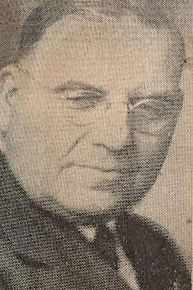
Early League member Harrison R. Merrill died in 1938
A blow came to the League that summer when one of the organization's founders and most important supporters passed away. Harrison Merrill, who was the head of the journalism department at BYU and an early cheerleader for the formation of the League, died at his home in August after a short illness. Olive Burt described him as being a “generous and rotund man” in her papers and talked about how he was dearly missed from that point on. He had been the main organizer for the first statewide meeting at Aspen Grove in Provo Canyon, which became the forerunner of The Roundup and eventually the Quills Convention each year.
He was only 54 years old when he passed away.
The third annual Writers Roundup was held by the Utah Chapter of the League of Western Writers on July 18 and 19, 1938 at Brigham Young University. It was held there in no small part by the influence of Harrison Merrill, a professor of journalism at the school. Only a few short weeks later Merrill passed away (see Pieces of the Past part eight) but his influence on the organization and conferences held would be profound for years to come.
Despite the organization’s lofty goal of only admitting “professional writers” when the group came together in late 1935, they realized that many writers had never been published and their presence at events such as the Roundup was valuable, possibly as much because of the financial realities as the artistic ones. The Roundup advertising and program stated “Who may attend? Anyone who is interested in writing and who will pay the registration fee.” That fee was $1.50 for all sessions over the two days or 60 cents per session. Remember it was the middle of the Great Depression. Today that $1.50 would translate into $32.88.
This conference featured a Poets Breakfast (which was conducted as the first session, unlike today when it is held on the morning of the last day of the conference) and general sessions. Attendees were expected to provide their own lunch on both days.

Ernest Haycox (photo from 1923)

Ethel Romig Fuller (undated photo)
One of the headliners at the conference was Ernest Haycox. While his name may not be recognizable to many today, during his career he wrote over twenty novels and published hundreds of short stories in what was then called “the pulps.” His story “Stage to Lordsburg”, which had just been published before he spoke at that year's Roundup, was made into the movie Stagecoach the next year (1939). That film made John Wayne a star and director John Ford a household name. Haycox also wrote the story for the basis of the movie Union Pacific, directed by Cecil B. Demille, and just before his death in 1950 he wrote the actual screenplay for the movie Montana, which starred Errol Flynn.
He told one session at the Roundup that there were two types of writers; those that indulge in wishful thinking and nothing of action, and those who really work. “You must be prepared to spend two or three years of apprenticeship without any acceptance of stories,” he said (Salt Lake Tribune, 07/19/38).
A long list of successful local writers and editors also spoke at the Roundup, including the poetry editor of The Oregonian, Ethel Romig Fuller.
The stage was now set for very professional conferences each year featuring nationally known figures from the literary world. At this conference, for the first time no officials from the League of Western Writers national organization appeared on the program. A change was coming soon to the Utah Chapter that would transform it into what is known as the League of Utah Writers today.
About the Author

Richard Shaw has been freelancing articles for local and national magazines for forty years. He has written about everything from cleaning toilets to cold case murder investigations. For fifteen years he worked in the newspaper business where he started as a government/ sports reporter, then editor and finally the publisher of two community newspapers. He was the President of the Utah Press Association in 2010. He presently owns Red Dog Communications, a venture which gets in the way of retirement. He is now writing fiction and poetry, the value of which remains to be seen. He lives in Helper, Utah with his wife Sherill and six dogs.